
Mastering Time Value of Money for the CFA Exam
The Time Value of Money (TVM) is a fundamental concept in finance and one of the most crucial topics you’ll encounter on the CFA exam. Whether you’re preparing for Level I, II, or III, a solid understanding of TVM is essential for passing the exam and for your career in finance.
In this guide, we’ll break down the key concepts of TVM, highlight common formulas, and provide strategies for mastering this topic.
What Is Time Value of Money (TVM)?
The principle of Time Value of Money asserts that money available today is worth more than the same amount of money in the future due to its potential earning ability. This concept is based on the idea of interest, which allows money to grow over time.
In essence, $100 today is worth more than $100 a year from now because of the opportunity to invest it and earn a return.
Why TVM Is Important for the CFA Exam
TVM is an essential concept in finance that is used in a variety of areas, such as:
- Valuing Bonds (Fixed Income)
- Stock Valuation
- Real Estate Investment Analysis
- Capital Budgeting (NPV, IRR)
A strong grasp of TVM is crucial for understanding concepts like present value (PV), future value (FV), and discounting and compounding, all of which are regularly tested on the CFA exam.
Key Concepts You Must Know
To master Time Value of Money, it’s essential to be familiar with the following key concepts:
1. Present Value (PV) and Future Value (FV)
- Present Value (PV) refers to the current value of a future sum of money, discounted at a specific rate. Essentially, it answers the question, “How much is $100 in 3 years worth today?”
- Future Value (FV) represents the value of a current sum of money at a specific point in the future, accounting for interest or returns earned over time.
2. Discounting and Compounding
- Discounting is the process of determining the present value of a future cash flow by applying a discount rate.
- Compounding is the opposite: it involves calculating the future value of a present amount by applying a compounding interest rate.
3. Annuities
An annuity is a series of equal payments made at regular intervals. There are two main types:
- Ordinary Annuities: Payments made at the end of each period.
- Annuities Due: Payments made at the beginning of each period.
4. Perpetuities
A perpetuity is a type of annuity that continues indefinitely. The formula for calculating the present value of a perpetuity is:

Where:
C = Cash flow per period
r = Discount rate or interest rate
TVM Formulas You Need to Know
The CFA exam frequently tests your ability to apply the key TVM formulas. Here are the essential formulas you must memorize and understand:
Future Value (FV)
The future value of a single cash flow is calculated using the formula:

Where:
FV = Future Value
PV = Present Value
r = Interest rate per period
t = Time (number of periods)
Present Value (PV)
To calculate the present value of a future cash flow:

Where:
FV = Future Value
PV = Present Value
r = Discount rate
t = Time (number of periods)
Annuity Formula (Ordinary Annuity)
To calculate the present value of an ordinary annuity:
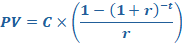
Where:
C = Cash flow per period
r = Interest rate per period
t = Time (number of periods)
For future value of an annuity:
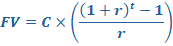
Perpetuity Formula
For the present value of a perpetuity:

Where:
C = Cash flow per period
r = Discount rate per period
Strategies for Mastering TVM
Here are some practical tips and strategies for mastering Time Value of Money for the CFA exam:
1. Practice with Real-World Examples
TVM can be abstract, but it becomes much easier when you relate it to real-world scenarios. Practice with investment decisions, such as comparing the present value of future cash flows or evaluating the future value of an investment.
2. Use a Financial Calculator
While you will be allowed to use a financial calculator on the CFA exam, it’s essential to become comfortable with the TVM functions on your calculator. Spend time learning how to input and calculate PV, FV, and annuities using your calculator to save time on exam day.
3. Break Down Complex Problems into Smaller Steps
Complex TVM problems often involve multiple calculations. Start by calculating individual components (e.g., finding PV or FV) before combining them into a more complex solution.
4. Use the Formula Sheet Wisely
The CFA exam provides a formula sheet, but you’ll need to be able to recognize when and how to apply each formula. Practice applying each formula until it becomes second nature.
Common Mistakes to Avoid
When studying TVM for the CFA exam, be mindful of these common mistakes:
- Misunderstanding the timing of cash flows: Pay attention to whether cash flows are due at the beginning or end of periods.
- Forgetting to adjust for the number of periods: Ensure that you’re using the correct number of periods in each formula.
- Confusing FV with PV: Always check which variable you’re solving for and make sure you’re using the correct formula.
Mastering Time Value of Money is crucial for success in the CFA exam and for your career in finance. By understanding the core concepts, memorizing key formulas, and practicing regularly, you’ll be well-prepared to tackle any TVM-related question on exam day.
Tip: Remember that practice makes perfect. The more problems you solve, the more confident and proficient you’ll become at using TVM to make financial decisions.
Good luck on your CFA journey, and stay focused!